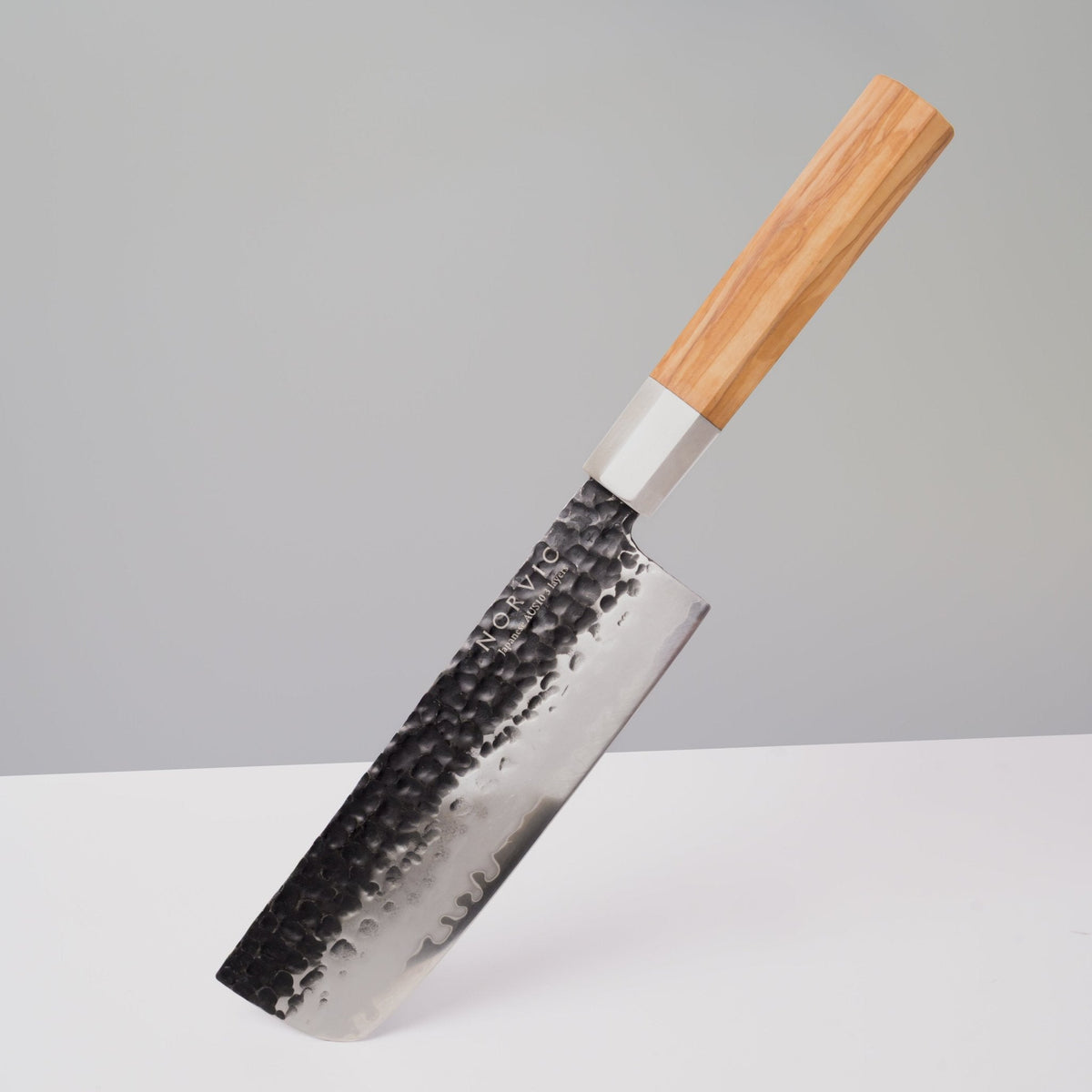
Put a cabbage, a few carrots, and an onion on the chopping board and the appeal of a nakiri becomes much easier to explain.
The name can make it sound like a knife for a particular cuisine, or something you need a lesson to understand. In practice, it is a vegetable knife. If you make soups, stews, slaws or a Sunday lunch with plenty of vegetables, you already have jobs for it.
Nakiri has a specific purpose, but the work it suits is very ordinary.
Look past the resemblance to a cleaver
A nakiri has a broad, rectangular blade and a relatively flat cutting edge. From a distance, it can look like something intended for heavy chopping. It needs a much lighter approach.
The shape suits controlled cuts through vegetables on a board. The flatter edge means you don't need the same rocking movement you might use with a curved chef knife. Lift, position and make the next cut, allowing the edge to reach the board gently.
That is particularly helpful with things such as spring onions or cabbage, where an incomplete cut can leave a row of pieces still attached at the bottom. You can concentrate on finishing each slice instead of lifting the whole tangled arrangement into the bowl.
Keep your fingertips tucked safely back and work at a pace you can control. The blade doesn't need to be raised high or brought down hard. This isn't a competition to see how quickly the chopping board can make a noise.
The meals that make the case for it
Take a pot of soup. There may be an onion, celery, carrots and a leek to prepare before anything else happens. None is a dramatic ingredient, but together they account for quite a lot of knife work.
Or consider a slaw. The difference between a pleasant forkful and a difficult one often starts with the thickness of the cabbage. Fine, reasonably even slices are useful here. So is taking a moment to cut the carrot to a size that belongs in the same mouthful.
I think this is where a vegetable knife earns its place. It gives attention to the preparation we tend to hurry through because we are thinking about the main part of the meal.
A casserole doesn't require identical little cubes. Vegetables of roughly similar size are usually a more practical aim. You can leave the ruler in the drawer and still make a noticeable improvement to the consistency of your preparation.
Our Blickling Nakiri pairs this blade shape with an olive wood handle and a hammered finish. It is finished by hand in Norfolk and supplied with a magnetic wooden blade guard. Those are details I like, but the reason to choose it is the amount of vegetable work you want it to do.
Give it the right jobs
If an ingredient feels too hard, too large or unstable, stop and reconsider the job rather than adding force.
With large vegetables, first make sure you have a stable piece to work on and a board that will not move. A bench scraper is useful for gathering chopped ingredients, saving you from dragging the cutting edge sideways across the board.
You will still want another knife for some tasks. Close trimming, working around a joint or peeling a small piece of fruit may suit a different shape. A nakiri doesn't need to replace every knife to be a worthwhile addition.
Look after it just as carefully once the chopping is done. Wash by hand, dry promptly and protect the edge. The olive wood handle on the Blickling also deserves to be kept out of the dishwasher and away from a long soak.
If most of your cooking starts with a pile of vegetables, this is a shape I would take seriously. You can appreciate it just as easily while making leek and potato soup as while preparing a Japanese meal. The cabbage has no preference about where the idea for the knife came from.
Share:
Where a good knife should live