A good knife spends a surprisingly small part of its life cutting food. The rest of the time it has to live somewhere.
That sounds obvious until you open a drawer and find the blade underneath a potato masher, with the handle caught in a whisk. Or you look at the worktop and realise the knife block has taken the very space where you wanted to put the chopping board.
I think storage deserves more thought than it usually gets. It affects how easily you can start cooking, how you look after the edge and whether the kitchen feels pleasant to use.
Start beside the chopping board
Before choosing a block or holder, put your board where you normally prepare food. Leave it there while you look around.
Where could the knives sit without crowding that space? Can you reach a handle comfortably? Would an open cupboard door get in the way? Is the proposed spot next to the steam from the kettle or the splash from the sink?
A storage solution can look lovely in an empty kitchen and become a nuisance once the ingredients come out.
It should also be somewhere secure and out of children's reach.
A drawer can work perfectly well
There is nothing wrong with keeping knives in a drawer if each blade has proper protection. A suitable insert or a correctly fitting guard keeps the edge away from loose utensils and makes reaching for a handle more predictable.
The problem is an uncovered knife moving about among other metal objects. Apart from the obvious risk to fingers, that is a poor way to look after a carefully finished edge.
If you prefer clear worktops, I wouldn't buy a block simply because you feel good knives ought to be on display. Protected drawer storage may suit you better. Choose something that fits the actual knives, and make sure the drawer closes freely.
That last point applies to guards as well. A guard needs to cover the blade securely, a loose cover borrowed from a different knife isn't much of a solution.
When a block makes more sense
If you like to see the knives and have space beside your preparation area, a block can make everyday use straightforward. You can find the right handle without opening anything, and the blades have an obvious place to go after washing and drying.
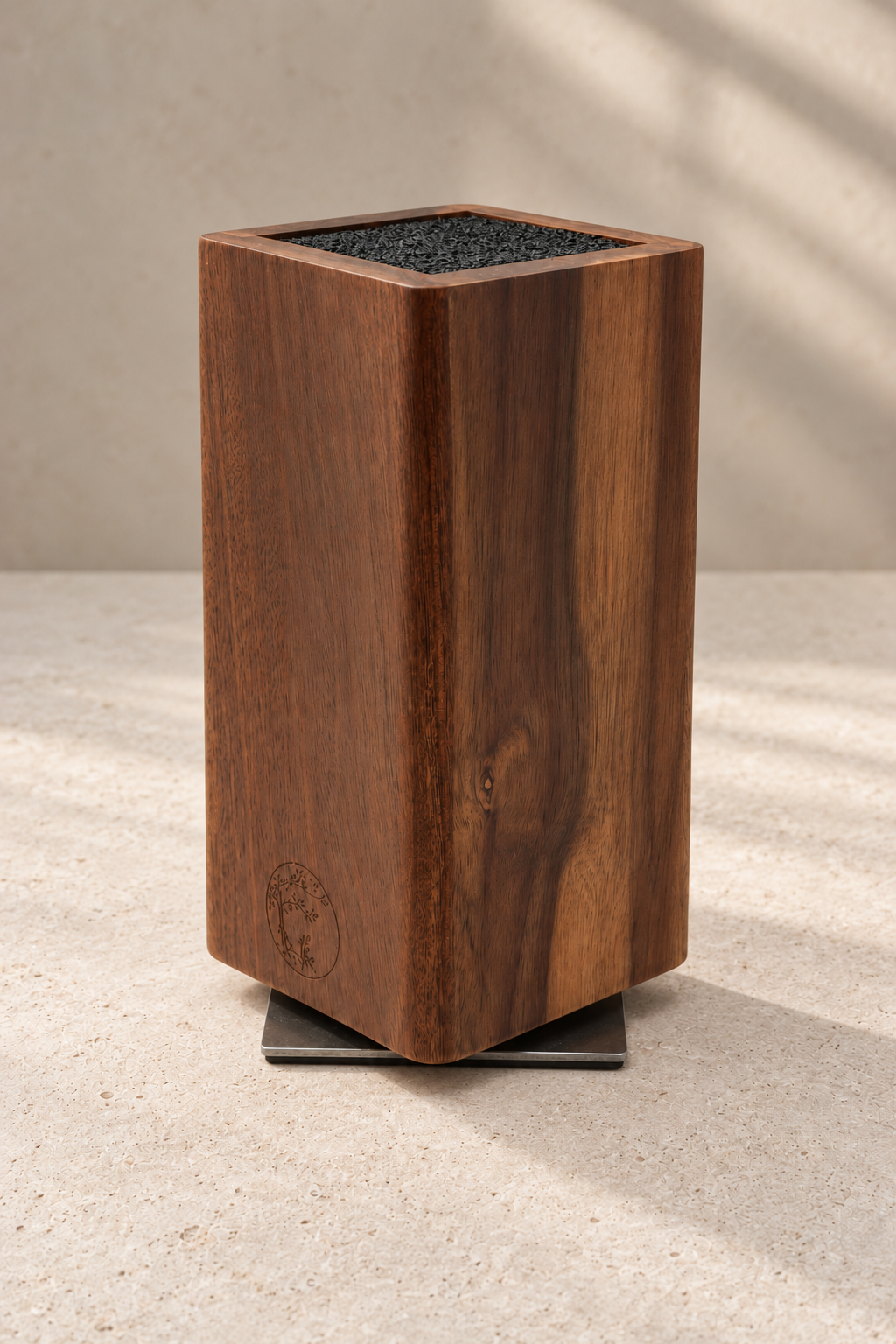
Our Norvic Rotating Magnetic Knife Block offers two ways to arrange them. The acacia exterior has magnetic storage, while a removable bristle insert holds suitable blades inside. The base turns through 360 degrees, so you can bring a handle towards you.
The useful question is how your knives will fit. Magnetic storage depends on a blade responding to a magnet, as well as its size, shape and weight. Internal storage depends on the usable depth of the insert. I would check those things before ordering, especially for an unusually long or heavy knife. Knives are sold separately.
Once it is in place, leave room between the handles. You should be able to take one knife without catching another. Check that each blade is securely supported before letting go, and turn the block gently.
Wood brings some welcome warmth to a worktop, but it still needs sensible care. Store only clean, completely dry knives. With our rotating block, the bristle insert lifts out for rinsing and must dry completely before it goes back. The wooden body should be wiped and dried rather than soaked.
I would resist filling every available space just because it is there. Give the knives you use most an easy place to live, and let the rest of the kitchen breathe. Being able to put your hand straight on the right handle is a small pleasure you get to enjoy every time you cook.
Share:
Before you buy another kitchen knife, look at what you cook