The "Two-Week" Myth
We’ve all been there. You unbox a shiny new kitchen knife from a big-name brand. You slice a tomato. It feels incredible. You think, "Finally, a good knife."
Two weeks later, you try to slice a pepper, and the blade skids off the skin.
You haven't lost your technique, and the steel hasn't suddenly gone bad. You have just become the victim of the biggest shortcut in the knife industry: The Wire Edge.
The Problem: Robots Run Hot
To understand why your knife went dull, you have to look at how it was made.
In mass production, knives are sharpened by high-speed belt grinders run by robots. These belts spin at thousands of RPM.
-
The Heat: Friction creates heat. If you overheat the very tip of a knife edge (the apex), you soften the steel. A soft edge rolls over quickly.
-
The Burr: High-speed grinding pushes the metal to the edge, creating a microscopic, floppy foil of steel called a "burr" or "wire edge."
Factories often use a quick buffing wheel to make the knife look shiny, but they rarely remove that wire edge completely.
When you first use the knife, that jagged wire acts like a serrated saw. It feels sharp! But because it's just a thin flap of metal, it folds over after a few uses. Suddenly, your "sharp" knife is blunt.
The Solution: The Norfolk Edge
At Norvic, we decided that "Factory Sharp" wasn't good enough for our customers.
That is why we have moved our finishing process in-house, right here in Norfolk. We don't just inspect the knives when they arrive; we finish them ourselves.

Here is how we fix the Factory Flaw:
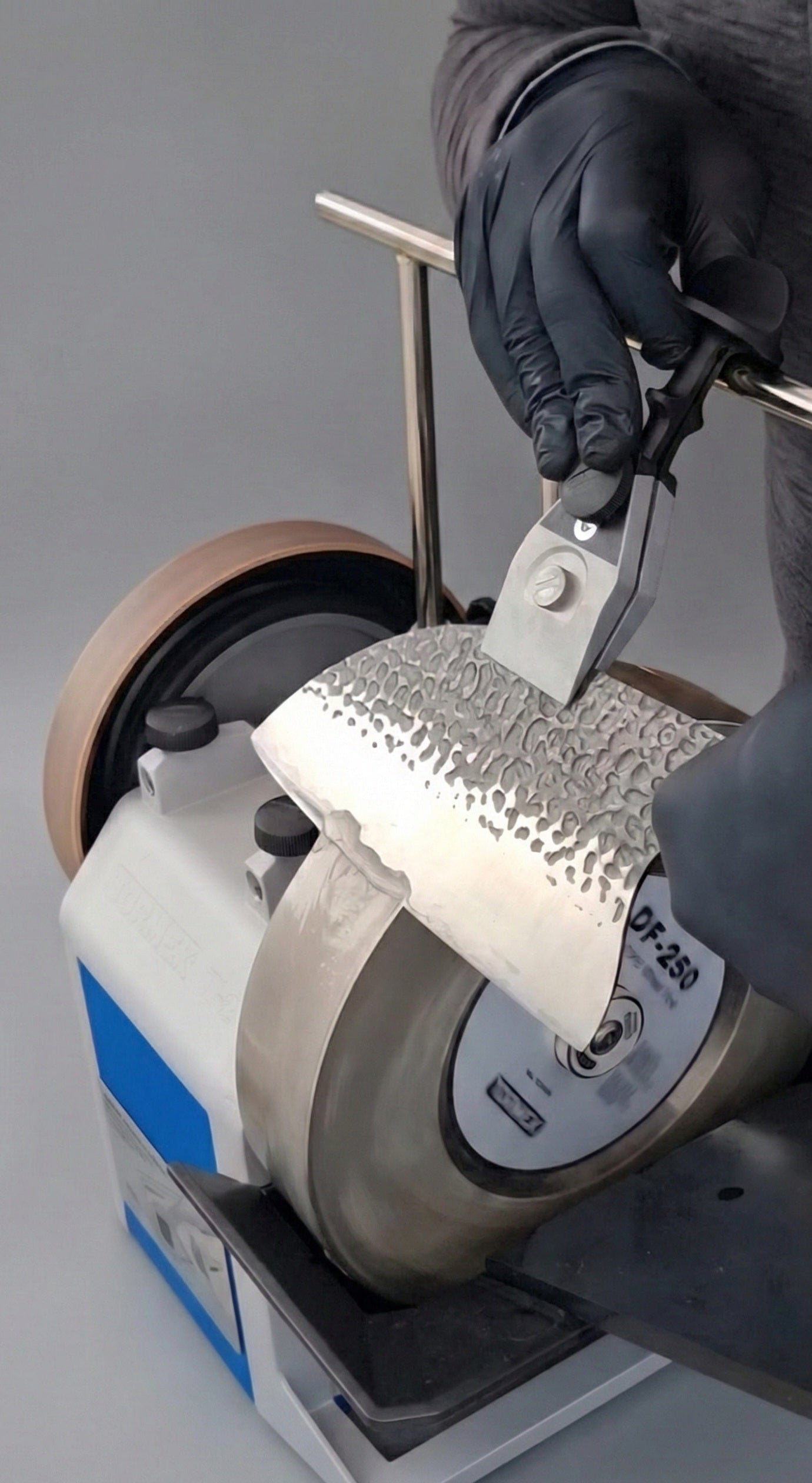
1. Water-Cooled Precision We refuse to use high-speed dry grinders. We use a Tormek Water-Cooled System. The stone runs slowly through a bath of water, keeping the steel ice-cold while we grind. This preserves the temper (hardness) of the blade, ensuring the edge stays stronger for longer.
2. The Diamond Difference Most sharpeners stop at a "standard" grit. We go further. After setting the geometry, we hone the blade on a leather wheel loaded with 6-micron diamond paste. This gently strips away that nasty wire edge that the factories left behind.
3. The 1-Micron Finish This is the step that makes a Norvic knife special. We finish every blade by hand on a leather strop using a 1-micron diamond suspension.
To put that in perspective: A standard human hair is about 70 microns thick. We are polishing the edge with diamonds that are 1/70th the size of a hair.

The Result?
A blade that doesn't just tear through food, it separates it.
Because we have removed the wire edge and polished the steel properly, the sharpness you feel out of the box is the true edge, not a false one. It won't fold over after two weeks.
It takes us a lot more time to do this. It costs us more in diamond compounds. But when you slice that first onion without crying, you’ll know exactly why we do it.
Don't just buy sharp. Buy Norvic Sharp.
Share:
The Cardinal Sin: Why Dishwashers Are Ruining Your Knives
The Ultimate Recap: Norvic Knives at the Norwich Camping and Leisure Big BBQ Weekend